

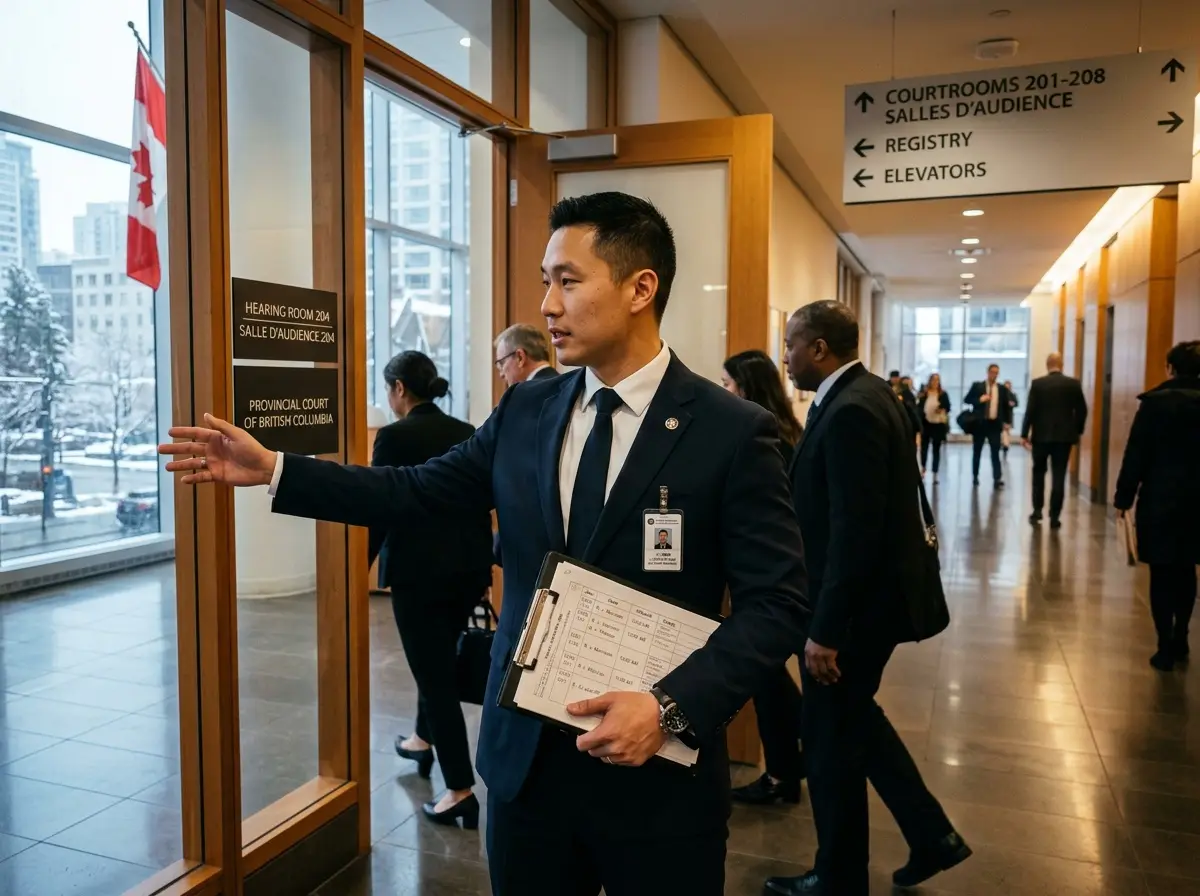
- This group performs some or all of the following duties:
- Court clerks
- Call courts of law to order, read charges, take pleas from defendants, swear in witnesses and perform other clerical functions in the courtrooms
- Prepare court files, court dockets and other documents
- Record main court proceedings, including pleas, names of witnesses, dates, times and rulings
- Manage care and custody of court exhibits
- Prepare documents for and participate in jury selection
- Update and maintain court office paper and electronic indexes and files on actions taken by court or in response to court decisions
- Receive, disburse and account for fines, fees and trust monies
- Assist the public in court offices.
- Court officers
- Stock courtrooms with necessary materials before trials
- Escort the judge to the courtroom
- Maintain the security and safety of the judge and courtroom
- Monitor proceedings and uphold the rules and procedures of the court
- Read charges and take pleas from defendants
- Transport prisoners to and from the court house and detention centres, psychiatric hospitals, police divisions, or elsewhere
- Maintain the security of prisoners in the cell area of courthouses and while escorting prisoners to and from courtrooms or elsewhere
- Maintain prisoner records.
- Court administrators
- Coordinate administrative services and establish work priorities for court staff
- Supervise court clerks and other court services occupations
- Schedule court trials, pre-trial conferences and hearings
- Oversee the maintenance of judicial court records
- Assist in preparing annual budgets
- May assist in the management of personnel, operations, and the court facilities.
Employment Requirements
- Completion of secondary school is required.
- On-the-job training is provided for court officers, court clerks, and court liaison officers.
- Special Constable Certification may be required for court officers and court liaison officers.
- Court clerks and court officers may require a 1-2 year post-secondary diploma in office administration or equivalent.
- Court administrators usually require a 1-2 year post-secondary diploma, or may require a university degree in law, business administration, judicial administration, or related field.
- Some experience as a court clerks may be required for court administrators.
- Experience in clerical services, administration and management, and personnel information systems may be required for court administrators.
Additional Information
1227 continues as 14103 and part transferred to 10019 and 42200