

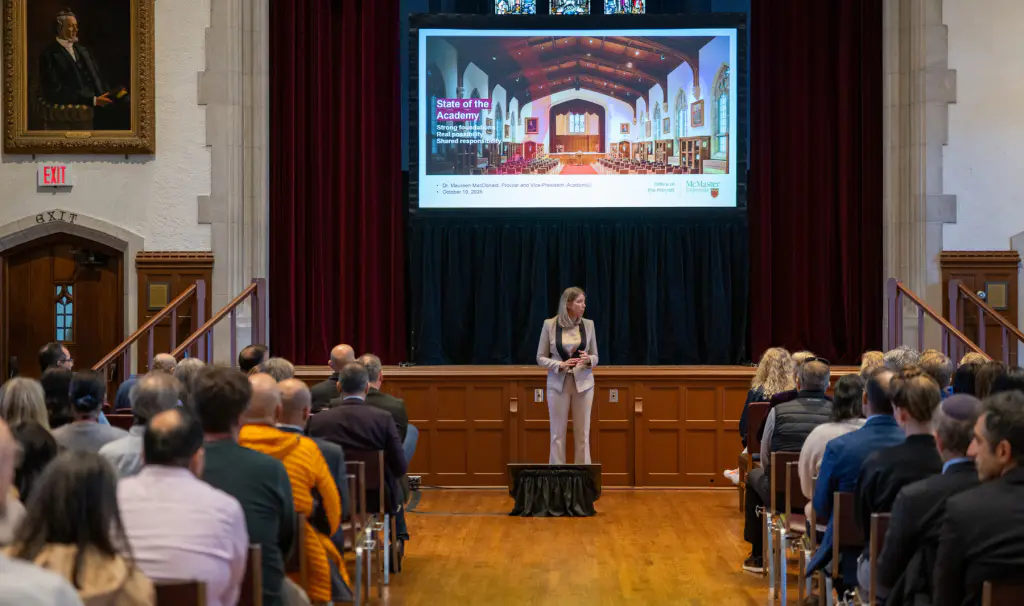
McMaster University has set out its academic, teaching, and interdisciplinary research roadmap during the 2026 State of the Academy address delivered on October 19 by Provost and Vice-President (Academic) Maureen MacDonald. Speaking to faculty, staff, and students in the Concert Hall alongside community members watching via livestream, MacDonald emphasized that McMaster’s next chapter depends on focusing institutional resources and academic strengths where the university can achieve the greatest global and regional impact.
Supporting a community of more than 37,000 students and over 250,000 alumni worldwide, McMaster University recently launched its new strategic plan, Bolder Together, as it prepares to mark its centennial in Hamilton in 2030. The address was accompanied by the Mac Moments gallery, showcasing cross-campus initiatives that connect teaching, discovery, and student success.
Academic Leadership Appointments and Global Faculty Recruitment
Over the past year, McMaster University has strengthened its academic leadership team and expanded its research capacity through key decanal appointments and international recruitment:
- Special Advisors to the Provost on Artificial Intelligence: Professor Bhagwati Gupta joined Stephanie Verkoeyen as the second Special Advisor to the Provost on AI, guiding responsible AI integration across teaching, curriculum design, and academic governance.
- Decanal Appointments and Renewals: Gillian Goward was appointed Dean of the Faculty of Science; Nancy Baxter joined as Vice-President and Dean of the Faculty of Health Sciences; Khaled Hassanein began a second term as Dean of the DeGroote School of Business; and Sean Corner assumed the role of Acting Dean of the Faculty of Humanities.
- Canada Research Chairs and International Scholar Recruitment: Ten McMaster researchers from Business, Engineering, and Science were appointed Canada Research Chairs in May 2026. In August 2026, five internationally recognized scholars from American universities were recruited to McMaster backed by a $43 million CAD federal research investment.
Teaching Innovation, Critical AI Literacy, and Collaborative Spaces
MacDonald highlighted how McMaster faculty are preparing students to think critically, evaluate information rigorously, and adapt to emerging technologies. Classroom innovations include assignments where students analyze intentionally flawed AI-generated scientific papers to sharpen their diagnostic reasoning, alongside experiential learning initiatives supported by the Student Success Centre, the MacPherson Institute, and the Disability Course Redesign Pilot.
New and revitalized campus spaces, including the McLean Centre for Collaborative Discovery and Lincoln Alexander Hall, are fostering interdisciplinary teamwork across faculties. In addition, McMaster is expanding lifelong learning pathways through professional certificates and micro-credentials so graduates and working professionals can continually upskill throughout their careers.
Financial Stability, Research Funding, and Next-Generation Institutes
Addressing the university’s consolidated financial outlook ahead of its multi-year budget release this spring, MacDonald noted that recent policy updates and targeted investments have strengthened McMaster’s financial position while disciplined expenditure management continues. Recent funding milestones and institutional platforms include:
- $294 Million CAD in Sponsored Research Income (2025): Reinforcing McMaster’s standing among Canada’s most research-intensive universities.
- $90 Million CAD Provincial Investment: Expanding student spaces and training capacity in high-demand academic programs across Ontario.
- $50 Million CAD Gift from the McCall MacBain Foundation: Establishing the McCall MacBain Institute for Kinesiology and Healthspan.
- Interdisciplinary Research Institutes and Innovation Hubs: Launching the McMaster Institute for Radiopharmaceutical Imaging and Therapy, the new Futures Institute at Wilson College (supported by an $8 million CAD gift from Red Wilson), plans for the NexusHealth Bioinnovation Building, and the Southern Ontario Innovation Hub (SOIH) in partnership with the National Research Council of Canada (NRC).
Key Takeaways and School Context
Situated on a 121-hectare campus in Hamilton, Ontario, McMaster University is a U15 public research university ranked among the world’s top 100 institutions. Its model of uniting six academic faculties with hospital networks, federal laboratories, and industry partners across Southern Ontario offers undergraduate and graduate students exceptional access to paid co-op placements, laboratory research, and flexible credential pathways. Prospective students and families interested in applying to McMaster University can contact our education advisory team for personalized admissions support.